UAE Textile Recycling and Circular Economy: PANECO®’s Vision for Textile Waste | Building a Textile Circular Ecosystem Through the UAE Textile Circular Pilot Plant
UAE Textile Recycling and Circular Economy: PANECO®’s Vision for Textile Waste
Building a Textile Circular Ecosystem Through the UAE Textile Circular Pilot Plant
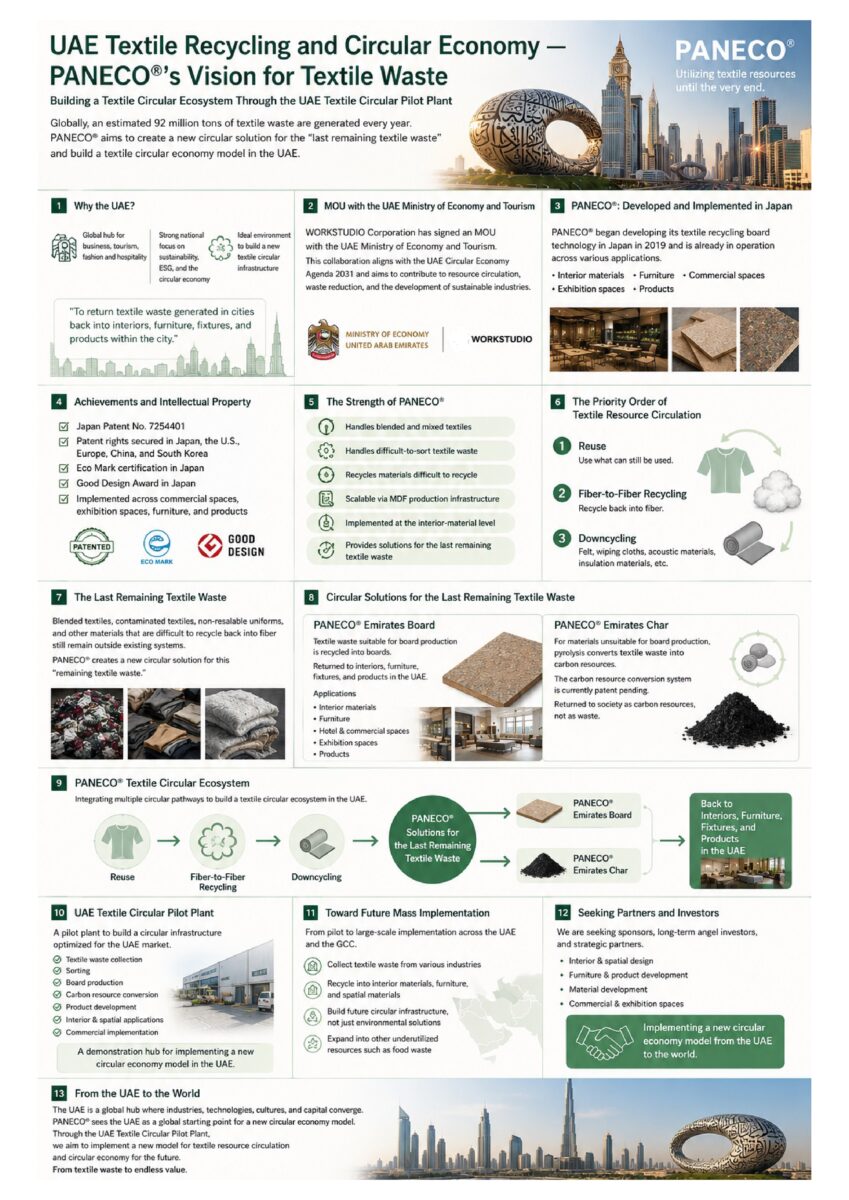
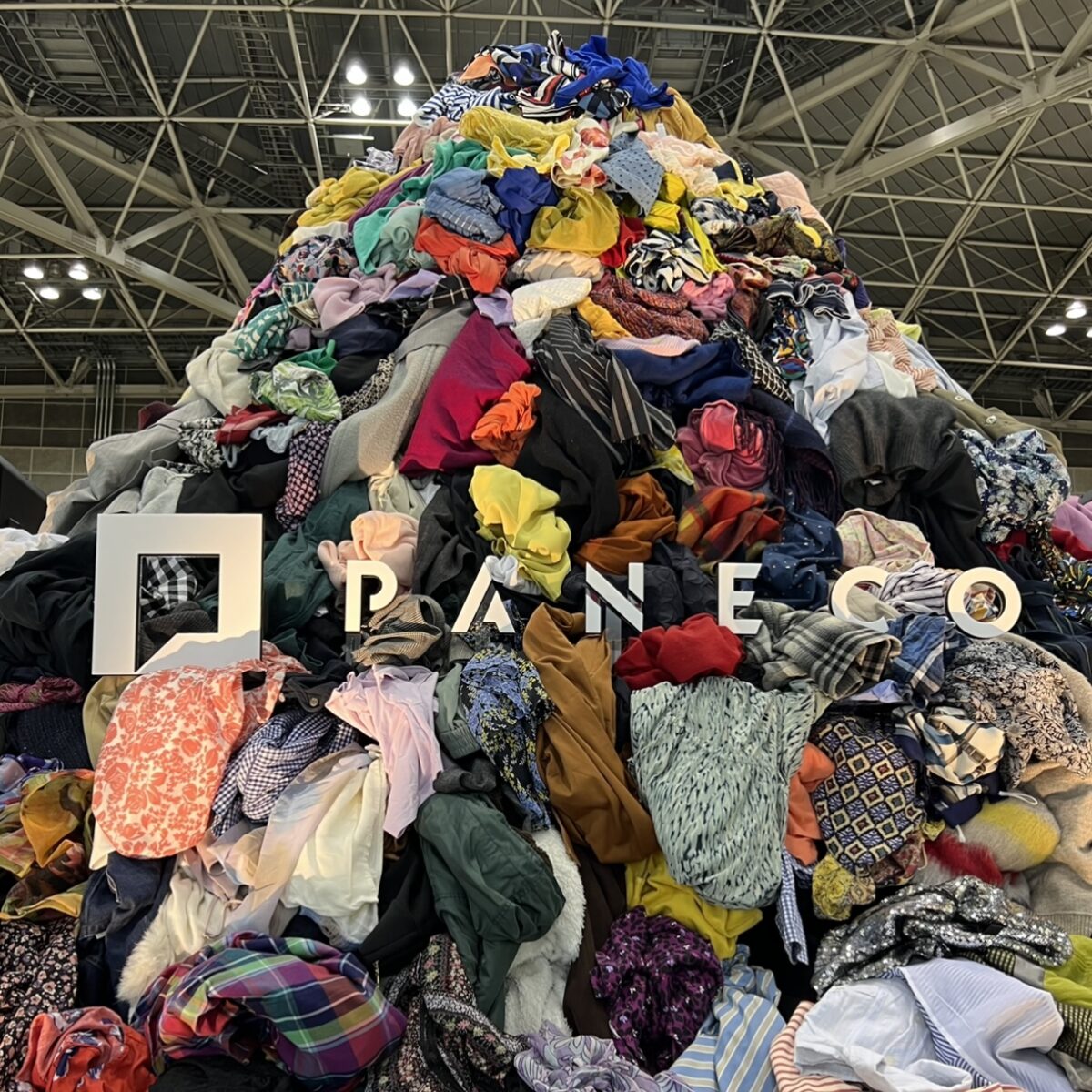
Globally, an estimated 92 million tons of textile waste are generated every year.
Yet today, systems capable of circulating textile waste without relying on incineration or landfill are still not fully established.
In particular, materials such as:
- blended textiles
- contaminated or deteriorated fabrics
- non-resalable uniforms
- curtains
- textiles that are difficult to recycle back into fiber
remain challenging for existing recycling systems around the world.
As a result, much of the world’s textile waste still cannot be fully processed through reuse, fiber-to-fiber recycling, or downcycling alone, and is ultimately incinerated or landfilled.
PANECO® aims to create a new circular solution for the “last remaining textile waste” that has traditionally been treated as waste for disposal.
Today, PANECO® is envisioning the social implementation of a new textile circular economy model in the UAE.
Why the UAE?
The UAE is one of the world’s leading urban development nations.
Hotels, commercial facilities, exhibitions, tourism, fashion, and hospitality industries are highly concentrated in the UAE, creating an environment where textiles and fabrics are continuously used and renewed.
At the same time, the UAE is actively advancing national strategies focused on sustainability, ESG, decarbonization, waste reduction, resource circulation, and the circular economy.
PANECO® strongly resonates with this direction.
We believe textile waste should not simply be treated as “waste,” but redefined as an urban resource that circulates within the city.
Our vision is:
“To return textile waste generated in cities back into interiors, furniture, fixtures, and products within the city.”
This is the foundation of a new circular infrastructure for textile resources in the UAE.
MOU with the UAE Ministry of Economy and Tourism
WORKSTUDIO Corporation has signed an MOU with the UAE Ministry of Economy and Tourism in the field of circular economy initiatives.
This collaboration aligns with the UAE Circular Economy Agenda 2031 and aims to contribute to resource circulation, waste reduction, and the development of sustainable industries in the UAE.
Through this initiative, PANECO® aims to help establish a new model for textile resource circulation and circular economy implementation in the region.
PANECO®: A Circular Material Technology Developed and Implemented in Japan
PANECO® began developing its textile recycling board technology in Japan in 2019.
Today, the technology is already being operated and implemented in Japan across applications such as:
- interior materials
- furniture
- commercial spaces
- exhibition spaces
- products
In addition, mass production of “PANECO® board M” is scheduled to begin in Japan in late 2026.
This model aims to achieve stable supply, scalability, and social implementation by utilizing existing MDF manufacturing lines in Japan.
PANECO® is not merely a research concept.
It is an implementation-driven project that has already advanced:
- textile waste collection
- board manufacturing
- product development
- spatial implementation
- circular resource systems
- mass-production planning
within Japan.
Furthermore, PANECO® has already achieved:
- Japan Patent No. 7254401
- patent rights secured in Japan, the United States, Europe, China, and South Korea
- Eco Mark certification in Japan
- Good Design Award recognition in Japan
- implementation across commercial spaces, exhibition spaces, furniture, and products
The UAE Textile Circular Pilot Plant is therefore not a project starting from zero.
It is a challenge to build a circular infrastructure optimized for the UAE market, based on years of implementation experience developed in Japan.
The Strength of PANECO®
PANECO® is not simply about turning textile waste into boards.
Its core strengths include:
- handling blended textiles
- handling difficult-to-sort textile waste
- recycling materials traditionally considered difficult to recycle
- scalability through MDF production infrastructure
- implementation at the interior-material level
- creating solutions for “the last remaining textile waste”
PANECO® does not compete with reuse or fiber-to-fiber recycling.
Instead, it aims to provide a new circular solution for textile waste that cannot be fully processed through existing recycling systems alone.
The Priority Order of Textile Resource Circulation
PANECO® does not believe all textile waste should immediately become boards.
Textile resource circulation should follow an appropriate priority order.
1. Reuse
Textiles and garments that can still be used should first be reused.
Direct reuse is one of the lowest environmental-impact solutions available.
2. Fiber-to-Fiber Recycling
Materials that can still be recycled back into fiber should proceed to fiber-to-fiber recycling.
This field is expected to continue evolving significantly in the future.
3. Downcycling
Additional recycling pathways such as:
- felt materials
- industrial wiping cloths
- acoustic materials
- insulation materials
also play an important role in textile circularity.
The Last Remaining Textile Waste
However, in reality, materials such as:
- blended textiles
- logo-marked uniforms
- contaminated or deteriorated textiles
- non-resalable textile waste
- textiles difficult to recycle back into fiber
still remain difficult to circulate through existing systems.
PANECO® aims to create a new circular solution for this “remaining textile waste” that falls outside current recycling systems.
Circular Solutions for the Last Remaining Textile Waste
PANECO® focuses on textile waste that has traditionally been incinerated or landfilled.
For these materials, PANECO® envisions two circular pathways.
PANECO® Emirates Board
Textile waste suitable for board production will be recycled into boards using PANECO®’s proprietary technology.
PANECO® Emirates Board is envisioned as a new circular material that returns textile waste collected in the UAE back into UAE interiors, furniture, fixtures, and products.
Potential applications include:
- interior materials
- furniture
- hotel and commercial spaces
- exhibition spaces
- products
This represents a circular system in which textile waste generated in cities is returned back into urban spaces.
PANECO® Emirates Char
For materials unsuitable for board production, highly contaminated textiles, or textile waste difficult to recycle through conventional methods, PANECO® envisions carbon resource conversion through pyrolysis processing.
The carbon resource conversion system behind this concept is currently patent pending.
Basic experimental verification has already been completed, and further validation toward social implementation is planned through the UAE Textile Circular Pilot Plant.
The resulting carbon resources are envisioned under the concept of “PANECO® Emirates Char,” with future possibilities being explored across multiple applications.
This is not disposal.
It is an initiative to return textile waste — previously destined for incineration or landfill — back into society as carbon resources.
PANECO® Textile Circular Ecosystem
What PANECO® aims to build in the UAE is not a standalone recycling technology.
The key is integrating multiple circular pathways appropriately:
- Reuse
- Fiber-to-fiber recycling
- Downcycling
- Circular solutions for the remaining textile waste
By becoming part of the textile resource circulation ecosystem, PANECO® creates a new pathway for textile waste that could not previously be circulated through existing systems alone.
PANECO® envisions a circular economy system that does not rely on incineration or landfill as the default solution.
Reusable textiles go to reuse.
Recyclable fibers return to fiber-to-fiber recycling.
Downcyclable materials go to alternative uses.
And the remaining textile waste is circulated through PANECO®.
This is the concept of:
“Utilizing textile resources until the very end.”
UAE Textile Circular Pilot Plant
PANECO® is not initially planning a large-scale mass-production factory.
The first step is a pilot plant designed to build a circular infrastructure optimized for the UAE market.
This facility will gradually validate:
- textile waste collection
- sorting
- board production
- carbon resource conversion
- product development
- interior and spatial applications
- commercial implementation
This pilot plant is not simply a factory.
It is a demonstration hub for implementing a new circular economy model in the UAE.
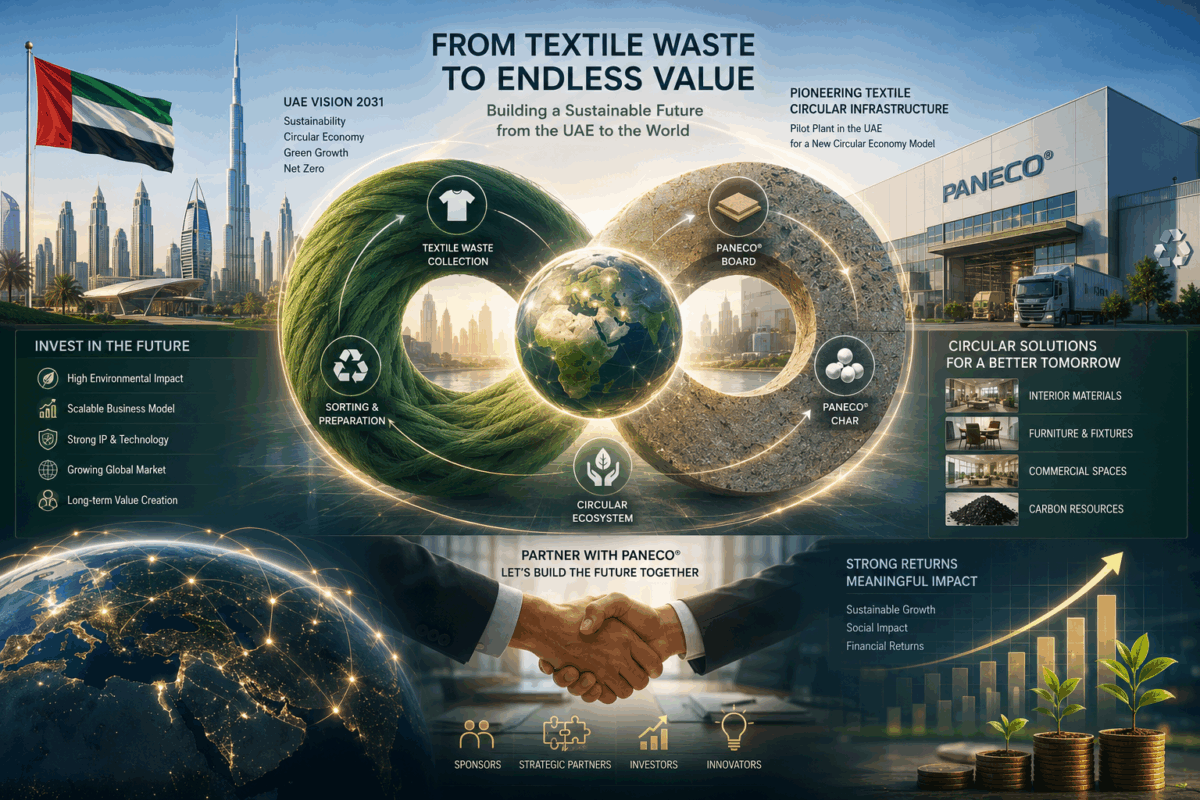
Toward Future Mass Implementation
PANECO® does not intend for this project to end at the pilot stage.
In the future, PANECO® envisions large-scale implementation and expansion across the UAE.
Textile waste generated from commercial facilities, corporations, exhibitions, fashion industries, and uniform-related industries will be continuously collected and recycled into interior materials, furniture, spatial materials, and products.
Ultimately, this model may expand not only across the UAE, but throughout the GCC region.
PANECO® sees textile recycling not merely as an environmental initiative, but as future circular infrastructure.
In the future, expansion into other underutilized resources, including food waste, is also being considered.
Seeking Sponsors, Strategic Partners, and Long-Term Angel Investors
PANECO® is currently seeking:
- sponsors
- long-term angel investors
- strategic partners
who resonate with the vision of the UAE Textile Circular Pilot Plant.
In addition, future collaborations are planned in areas such as:
- interior and spatial design
- furniture and product development
- material development
- commercial and exhibition spaces
PANECO® is not simply seeking financial investment.
We are seeking partners who share the vision of:
“Implementing a new circular economy model from the UAE to the world.”
This is not a project driven solely by short-term financial returns.
It is a long-term challenge to help build a new circular infrastructure for textile resources in the UAE.
From the UAE to the World
The UAE is a country where industries, technologies, cultures, and capital from around the world converge.
For this reason, PANECO® sees the UAE not merely as an overseas expansion destination, but as a global starting point for a new circular economy model.
Textile waste should not remain something to discard.
It should become a resource that returns to society with new value.
Through the UAE Textile Circular Pilot Plant, PANECO® aims to help implement a new model for textile circularity and resource circulation for the future.
And as a member of the Emirates community, PANECO® will continue striving together with the UAE toward the realization of a new circular economy.
From textile waste to endless value.
Textile Resource Circular Platform | PANECO®
PANECO® is a textile resource circular platform developed in Japan that transforms textile waste into circular materials, products, and spatial applications. Through textile recycling, resource circulation, and circular economy initiatives, PANECO® aims to build a sustainable infrastructure where textile waste is continuously circulated instead of being incinerated or landfilled.
Contact