
PANECO® Philosophy
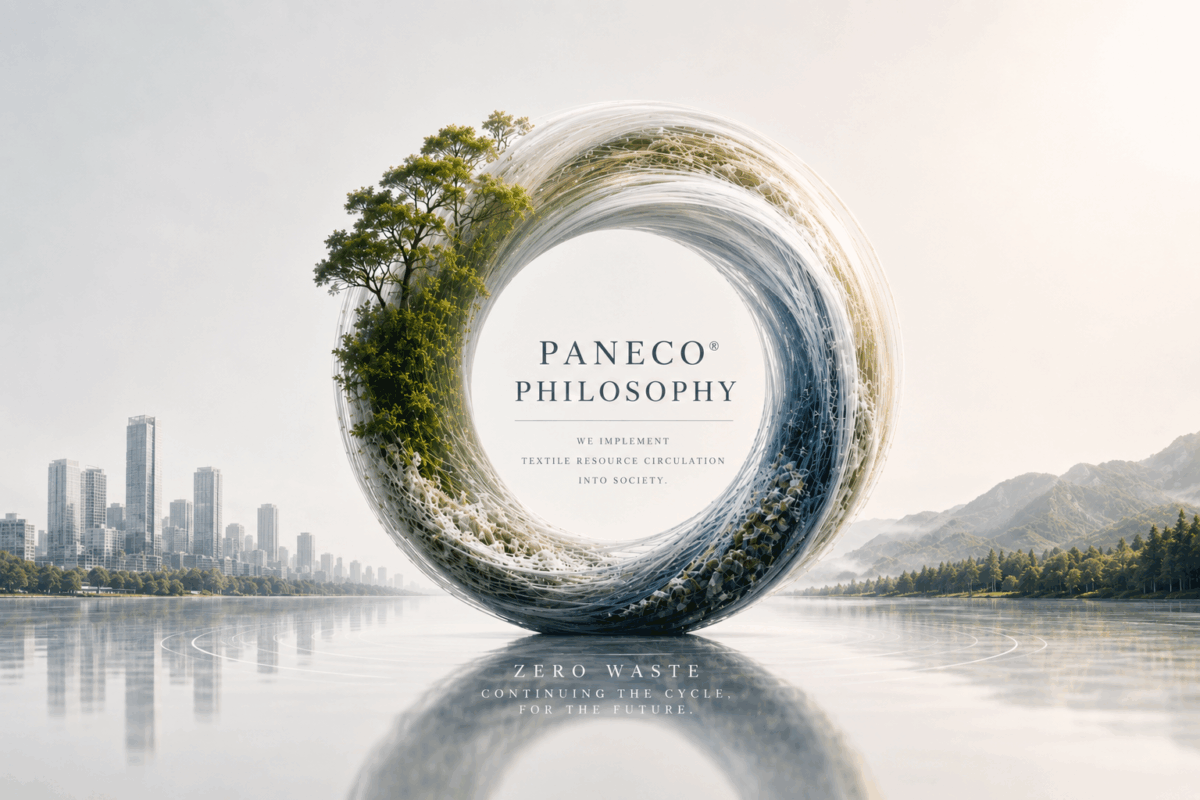
PANECO® Philosophy
Preface
It began with a single board.
Regenerating textiles that had completed their original role into a new board.
That was PANECO®’s first challenge.
The board was completed.
But the real challenge began there.
As we brought the completed board into society, we began to see a reality that could not be addressed by creating a single board alone.
To be used in society.
To be collected after completing its role.
To take on the next role as a new material.
And to be used once again within society.
Each of these was a world we could not yet see while we were developing the board.
The more we put it into practice, the more the questions expanded beyond a single board.
What is a resource?
What is circulation?
What is social implementation?
This text presents the PANECO® Philosophy we arrived at through practice, while continuing to face those questions.
The challenge that began with a single board eventually expanded into the philosophy of Textile Resource Circulation, nurturing a new way of seeing society.
What is written here is not the development history of a single product.
It is a philosophy we arrived at in order to socially implement Textile Resource Circulation.
Chapter 1
The Board Is Not the Goal
PANECO® began with the development of a single board.
Its first goal was to regenerate textiles that had fulfilled their original purpose into a new board—a material that could once again serve society.
A single board was completed.
But the real challenge began with that achievement.
To be accepted and used in society, it needed the performance required of a building material.
It needed the quality expected of furniture.
It needed the design value demanded of a material that shapes spaces.
It also required a production system capable of delivering consistent quality at scale.
As we addressed each of these challenges and advanced its social implementation, we came to realize that creating a single board was only the beginning.
A board fulfills its purpose only when it is used in society.
And once that purpose has been fulfilled, it must be collected, regenerated, and passed on to its next role.
The more we put it into practice, the more clearly we saw the real challenge that lay beyond the board itself.
The board was not only a product to be created.
It was also the gateway through which resources could move from one role to the next within society.
The board was never the goal.
It was the first step that led PANECO® toward a new philosophy: Textile Resource Circulation.
Chapter 2
Urban Forest
As PANECO® board found its way into society, our perception of resources began to change.
Wood-based boards are made from timber grown in forests.
For generations, forests have supplied the materials that shape our buildings, furniture, and interior spaces.
But where do the textiles used to create PANECO® board come from?
The answer lies not in forests, but in cities.
Clothing worn in everyday life.
Uniforms used by companies and schools.
Linens and curtains that have served hotels, offices, and commercial spaces.
Cities hold an immense accumulation of textile resources, generated through everyday life and social activity.
Until now, most of these materials have been regarded as waste once they had fulfilled their original purpose.
Yet through the continued practice of PANECO® board, we began to see them differently.
If timber supplied by forests can be regarded as a resource, then why shouldn’t the textiles that exist within our cities be viewed in the same way—as resources that continue to support society?
In the field of metals, there is the concept of the Urban Mine—the idea that used products within cities can be recognized as valuable resources.
When we extended that perspective to textiles, we arrived at a new realization.
A city is not merely a place where resources are consumed.
It is also a reservoir of textile resources waiting to take on their next role.
PANECO® calls this way of seeing resources the Urban Forest.
Urban Forest is the idea that textile resources existing within cities should be recognized as resources that support society, just as forests provide timber.
The journey that began with a single board did more than create a new material.
It transformed the very way we see resources.
Chapter 3
Urban Circulation
Once we began to see cities as resources, another realization emerged.
Resources do not circulate simply because they exist.
Cities contain textile resources that have fulfilled their original purpose.
But their mere existence does not enable them to support society.
They must be used.
They must fulfill a purpose.
They must be collected.
And they must be passed on to their next role.
Only when each of these stages is connected do resources truly circulate within society.
As we brought PANECO® board into society, we encountered this reality time and again.
A board can be made.
But if it is never used, circulation never begins.
Even if it is used, if it is not collected after fulfilling its purpose, the cycle ends there.
Even if it is collected, if it is not put back into use, it can never move on to its next role.
Circulation is not a single process.
It is a system through which resources continuously move through society while inheriting new roles.
This led us to another realization.
Textile resources generated in cities can take on new roles within those same cities.
Corporate uniforms and clothing are transformed into PANECO® board.
The board becomes furniture, building materials, and interior finishes.
It takes on a new purpose as a material that supports urban spaces.
And once that purpose has been fulfilled, it is collected again and passed on to its next role.
Resources born in cities become materials that support cities, continually inheriting new roles within the urban environment.
PANECO® calls this vision Urban Circulation.
Urban Circulation is not simply about recycling within cities.
It is a social system in which the resources that exist within cities continue to support the value of the city itself by continually inheriting new roles.
Chapter 4
Self-Circulation
As the idea of Urban Circulation took shape, a new question emerged.
Who is the true participant in circulation?
As we put the circulation of corporate uniforms into practice, one challenge became clear.
Companies send uniforms that have fulfilled their purpose to be collected.
Those uniforms are transformed into new resources and reborn as different products.
Yet in the process, they lose their connection to the organizations from which they came.
Companies are participating in circulation.
And yet, they rarely have the opportunity to see what new roles their own resources go on to fulfill.
Circulation becomes something that happens somewhere else, while the very organizations that generated those resources remain disconnected from the value created through the process.
This led us to a new idea.
What if those resources could return to where they came from?
Used uniforms are collected.
They are regenerated into PANECO® board.
The board becomes furniture.
It becomes interior finishes.
It becomes materials that support offices, stores, and showrooms.
The resources once generated by a company return to its own spaces in a new form.
At that moment, circulation is transformed from a process of disposal into a process of value creation.
Employees experience, in their everyday environment, how the uniforms they once wore have taken on a new purpose.
Visitors, in turn, encounter the company’s commitment to resource circulation through the very spaces they occupy.
Circulation no longer exists only in sustainability reports or environmental data.
It becomes something that can be seen, experienced, and carried forward in everyday business activities.
Through this practice, we arrived at another realization.
Circulation does not end with returning resources to society.
It also means transforming those resources into new value and bringing them back into the activities of those who generated them.
PANECO® calls this philosophy Self-Circulation.
Self-Circulation does not mean carrying out recycling in-house.
It is the idea of transforming the resources you generate into new value and integrating them back into your own activities.
Those who generate resources are not outside the circulation system.
They are themselves essential participants in creating it.
Chapter 5
The Textile Resource Circulation Ecosystem
As the idea of Self-Circulation took shape, an even greater reality came into view.
The circulation of a single company alone cannot realize Textile Resource Circulation across society.
Society contains an extraordinary diversity of textile resources.
They differ in material.
They differ in purpose.
They differ in their condition after completing their original role.
For that reason, no single company, no single process, and no single technology can create a complete circulation system for society.
As we advanced social implementation, we encountered this reality time and again.
It led us to a new realization.
What society needs is not a single outstanding recycling technology.
It needs a social system in which each participant fulfills its role and connects with others, allowing circulation to function as a whole.
Every resource has its own most appropriate pathway of circulation.
The goal is not to make one technology handle everything.
Rather, each form of circulation should fulfill its own purpose while connecting with others to create a stronger, more resilient system.
Textile Resource Circulation cannot be achieved by a single technology.
There is a role for collecting resources.
A role for regenerating them.
A role for putting them back into use.
And a role for returning them to circulation once they have fulfilled that new purpose.
Only when these roles are connected does a true circular system come into being.
Just as paper, glass bottles, and aluminum cans continue to circulate through society, textile resources must also become part of an enduring social system.
Resources are collected.
Sorted.
Regenerated.
Manufactured into new products.
Put to use.
And returned to circulation once again.
When the diverse participants responsible for each of these roles work together as one connected system, circulation continues without interruption.
The goal is not to expand a single technology.
It is to connect every stage of the cycle—
from collection to regeneration,
from regeneration to utilization,
and from utilization back to collection—
so that Textile Resource Circulation continues to function seamlessly across society.
PANECO® calls this social system, in which diverse participants share responsibilities while sustaining one continuous cycle, the Textile Resource Circulation Ecosystem.
Chapter 6
Optimal Circulation
As the concept of the Textile Resource Circulation Ecosystem took shape, another important realization emerged.
No single method can circulate every textile resource.
Society contains an extraordinary diversity of textile resources.
They differ in material.
They differ in purpose.
They differ in the environments in which they are used.
They differ in their condition after fulfilling their original role.
For that reason, choosing the most appropriate pathway of circulation for each resource is essential.
PANECO® does not seek to replace existing recycling systems.
Reuse has its own important role.
Fiber-to-fiber recycling has its own important role.
Technologies that regenerate textiles into products such as industrial wiping cloths and felt also have their own important role.
Each of these forms of circulation is valuable and should continue to evolve.
At the same time, there are textile resources that cannot be effectively utilized through these existing pathways alone.
Contaminated textiles.
Severely degraded textiles.
Textiles that are difficult to regenerate using conventional methods.
For many of these resources, there have been few viable options beyond disposal.
PANECO® seeks to provide these resources with another pathway—another opportunity to remain in circulation.
The goal is not to make one technology handle everything.
It is to choose the most appropriate form of circulation for each resource, allowing every technology to fulfill the role for which it is best suited.
When each pathway performs its own role and complements the others, society’s overall capacity for circulation grows stronger.
PANECO® is not here to replace existing systems.
It is one part of a broader ecosystem, supporting and expanding the possibilities of resource circulation.
This is what PANECO® calls Optimal Circulation.
Chapter 7
A New Social Infrastructure
As the concept of the Textile Resource Circulation Ecosystem took shape, another important realization emerged.
Creating a system for circulation is not the same as embedding that system into society.
The efforts of individual companies or isolated initiatives alone cannot establish circulation across society.
Only when it functions as a system embraced by society as a whole can resource circulation become truly sustainable.
Paper, glass bottles, and aluminum cans continue to circulate not simply because effective recycling technologies exist.
There are collection systems.
There are sorting rules.
There are institutions that support them.
And there is a broader social framework that enables all of these systems to function together.
That is why their circulation is no longer regarded as something exceptional.
It has become part of everyday society.
Textile Resource Circulation must reach the same stage.
Companies provide products and services designed with circulation in mind.
Users return resources after they have fulfilled their purpose.
Collection and recycling businesses connect those resources to their next life.
Public institutions establish the policies and systems that support circulation across society.
Only when each fulfills its role as part of one connected system can Textile Resource Circulation become embedded in society.
For that to happen, technological innovation alone is not enough.
Society also needs collection systems, institutional frameworks, and public policies that make circulation the standard rather than the exception.
In the future, legislation that advances Textile Resource Circulation across society will also play an important role.
Its purpose is not to support any single company.
Its purpose is to build the foundations of a sustainable society.
Just as roads support the movement of people and goods, water systems sustain everyday life, and electricity powers industry, Textile Resource Circulation has the potential to become part of the essential infrastructure that supports society.
The transition is not simply from a society that discards resources to one that circulates them.
It is a transition to a society in which resources continually inherit new roles.
The social system that enables this transformation is what we call a New Social Infrastructure.
Making Textile Resource Circulation an ordinary part of society—
that is PANECO®’s vision of a New Social Infrastructure.
Chapter 8
Social Implementation
Creating a new system is not enough to make it part of society.
Even the most advanced technology cannot change society on its own.
Even the best product creates no value unless it is embraced and used.
For PANECO®, Social Implementation is not about introducing a new technology or promoting a new product.
It is about making a new system an ordinary part of everyday society.
To achieve that, the system must be capable of expanding across society as a whole.
A technology that works only in a limited place or for a limited number of organizations can never become part of society’s infrastructure.
Only technologies that can be widely adopted can truly achieve Social Implementation.
That is why PANECO® has never sought to build an entirely new industry from the ground up.
Society already possesses an industrial foundation built over generations.
Advanced manufacturing technologies.
Established production facilities.
Quality assurance systems.
Reliable supply chains.
These are invaluable assets that society has cultivated over many years.
PANECO® seeks to build upon these existing strengths to bring Textile Resource Circulation into society.
Its technologies have been developed with this philosophy from the very beginning.
One expression of that philosophy is PANECO® board.
PANECO® board was never created to establish a new industry.
It is a model for Social Implementation—one that expands Textile Resource Circulation across society by making full use of the industrial foundation that already exists.
Society is not transformed by new ideas alone.
Lasting change happens when new ways of thinking are combined with the technologies, industries, and capabilities that society has already built.
In the same way, Textile Resource Circulation will become part of everyday society through steady practice, evolving into a system that can be passed on to future generations.
PANECO® does not seek simply to promote a product.
Its goal is to make Textile Resource Circulation an ordinary and enduring part of society.
That is what PANECO® means by Social Implementation.
Chapter 9
Resource Security
The concept of Urban Forest began with a simple shift in perspective: seeing the textile resources that exist within our cities as assets to society.
As that perspective expanded, it led us to another realization.
Resource circulation is more than an environmental initiative.
It is also a matter of Resource Security.
Every day, textile resources complete their original purpose.
Yet they do not lose their value the moment that purpose ends.
When they are properly collected, regenerated, and given a new role, they once again become resources that support society.
Transforming what was once regarded as waste into valuable social assets.
It is the accumulation of these efforts that gives society the capacity to keep resources in circulation.
Resource Security is not simply about securing access to new resources.
It is about building the ability to continually make use of the resources that already exist within society.
As geopolitical uncertainty, fluctuating resource prices, and supply-chain risks continue to grow, ensuring a stable supply of resources has become more important than ever.
That is why the ability to circulate the resources that already exist within our own society will become increasingly valuable in the years ahead.
Cities are not merely places where resources are consumed.
They are places where resources can continue to circulate.
Textile Resource Circulation is not simply an environmental technology.
It is part of the foundation that supports a sustainable society and a system that strengthens future Resource Security.
PANECO® does not seek simply to promote a product.
Its goal is to keep the textile resources that exist within our cities circulating as valuable social assets, passing them on to future generations.
Protecting resources is not only about finding new ones.
It is about continuing to make the best use of the resources we already have.
That is what PANECO® means by Resource Security.
Chapter 10
Zero Waste
— The Culmination of the PANECO® Philosophy —
For PANECO®, Zero Waste does not simply mean eliminating waste.
It means ensuring that resources continue to take on new roles, circulating through society even after fulfilling their original purpose.
It means creating a society in which resources never lose their purpose.
That is what Zero Waste means to PANECO®.
Resources do not lose their value the moment they have fulfilled their original role.
When they are properly collected, regenerated, and given a new purpose, they once again become assets that support society.
As this cycle continues, resources continue to inherit new roles.
Society is not sustained by a single form of circulation.
There is reuse.
There is fiber-to-fiber recycling.
There are diverse forms of regeneration suited to different applications.
When each resource is guided to its most appropriate pathway of circulation, and each technology and system fulfills the role for which it is best suited, society’s overall capacity for circulation becomes stronger.
Circulation cannot be achieved by a single company.
Nor can it be achieved by a single technology.
Only when each participant fulfills its role and connects with others can resources continue to circulate throughout society.
Zero Waste is not a society without waste.
It is a society in which resources continue to inherit new roles.
Protecting resources is not only about securing new ones.
It is about continuing to make the best use of the resources that already exist.
PANECO® does not seek simply to promote a product.
Nor does it seek merely to expand a single technology.
Its goal is to realize a society in which resources continually inherit new roles.
A society where resource circulation is no longer an exceptional effort, but an ordinary part of everyday life.
A society where resources continue to serve new purposes.
That is the culmination of the PANECO® Philosophy.
That is the Zero Waste envisioned by PANECO®.
Epilogue
From Philosophy to Social Implementation
PANECO® began with the creation of a single board.
But what we truly sought to bring into society was never just a board.
It was a new social system built on Textile Resource Circulation.
Its realization cannot be achieved by a single technology.
Nor by a single company.
There are businesses.
There are governments.
There are educational institutions.
There are research organizations.
There are recycling companies.
There are manufacturers.
And there are the people who sustain the entire cycle.
Only when each fulfills its role and connects as part of one continuous system can Textile Resource Circulation become truly embedded in society.
A philosophy does not exist simply to be expressed.
It exists to be put into practice, passed from one generation to the next, and carried forward into the future.
PANECO® does not seek merely to promote a single product.
Its goal is to make Textile Resource Circulation an ordinary and enduring part of society.
That challenge continues.
From Philosophy to Social Implementation.